
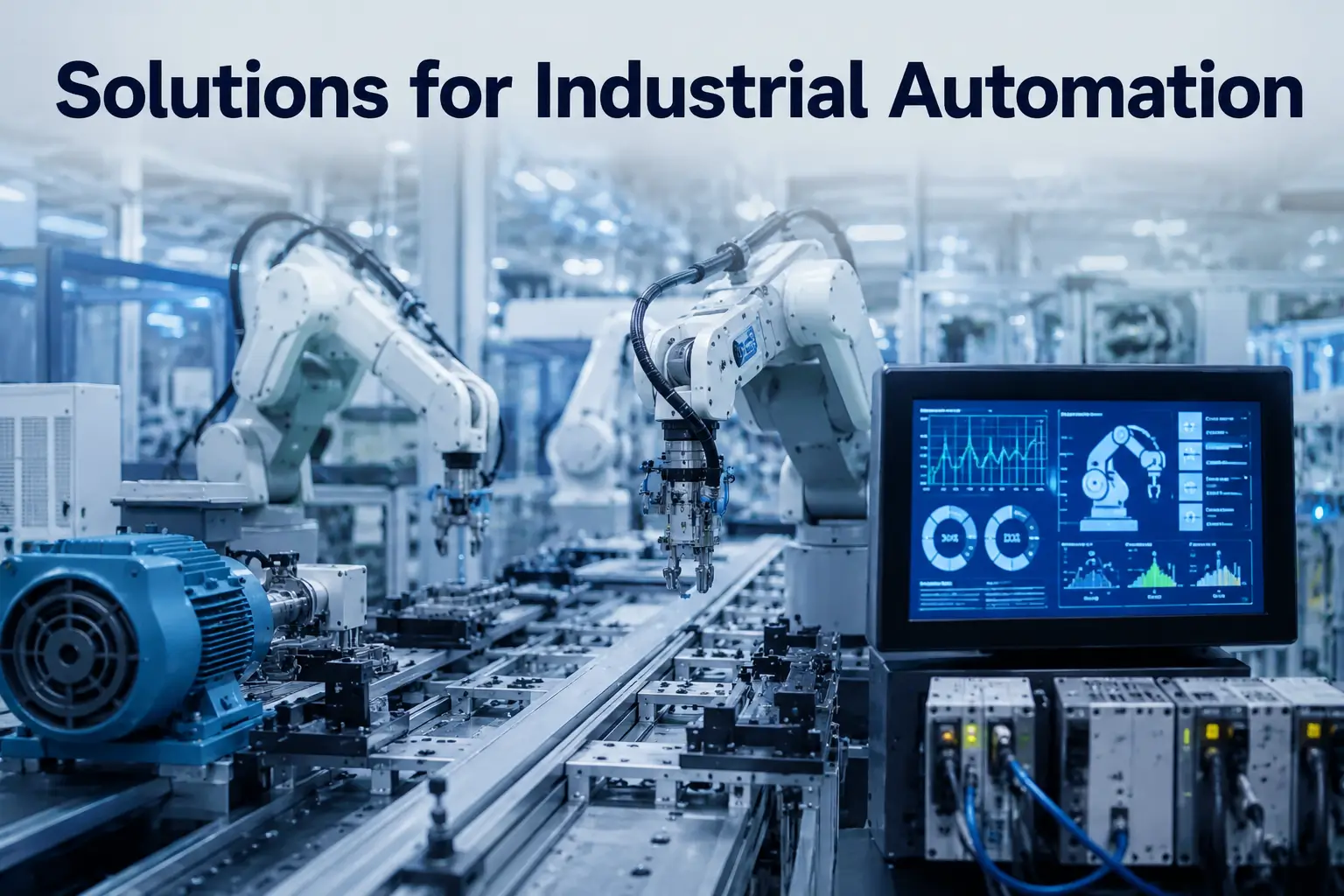
Manufacturing is changing fast. Factories today look very different from just a few years ago. A big part of this change comes from solutions for industrial automation. These tools are helping businesses work faster, safer, and more efficiently.
At WebInKey, we want to make this topic easy to understand. This guide breaks down what industrial automation really means, why it matters, and what trends are shaping its future.
By the end of this article, you will understand the technologies behind solutions for industrial automation and how they are changing the way businesses operate.
Many business owners hear the term automation and immediately think of expensive robots or complicated software. In reality, automation covers a wide range of solutions, from simple sensors to advanced AI systems. This guide will break down these ideas step by step, using plain language instead of technical jargon.
We will also look at how different industries use automation, what benefits it offers, and how businesses can decide which solutions fit their specific needs. The goal is to give you a complete and practical understanding of this important topic.
What are Solutions for Industrial Automation?
Solutions for industrial automation are systems and technologies that help machines perform tasks with little or no human control. These tools are used in factories, warehouses, and production lines to improve speed and accuracy.
Instead of relying only on manual labor, businesses use automated systems to handle repetitive or complex tasks. This includes everything from assembly lines to quality checks.
Here is what these solutions usually include:
- Robotic arms for assembly and packaging
- Sensors that monitor equipment performance
- Software systems that control production processes
- Automated inspection tools for quality control
The goal is simple. Reduce manual effort, improve consistency, and increase overall efficiency in industrial settings.
Automation is not about removing people from the workplace entirely. It is about giving them better tools to work with. Instead of spending hours on repetitive tasks, workers can focus on monitoring systems, solving problems, and improving processes.
This shift changes the nature of many industrial jobs. Employees often move from performing manual labor to managing and maintaining automated systems. This requires new skills, but it also creates safer and more efficient working environments overall.
Why Solutions for Industrial Automation Matter Today
Modern manufacturing faces constant pressure to produce more, faster, and with fewer mistakes. This is exactly why solutions for industrial automation have become so important.
Businesses today operate in highly competitive markets. Companies that adopt automation early often gain a strong advantage over those relying only on manual processes. This advantage can show up in lower production costs, faster turnaround times, and better overall product quality.
Here is why this matters:
- Automation reduces human error in repetitive tasks
- It increases production speed without sacrificing quality
- It helps businesses handle labor shortages more effectively
- It supports consistent output even during high demand periods
Beyond large factories, even smaller manufacturing businesses are adopting automation. As tools become more affordable, automation is no longer limited to big corporations.
Labor shortages have also pushed many industries to consider automation seriously. When it becomes difficult to find enough skilled workers, automated systems can help fill important gaps in production. This does not eliminate the need for human workers, but it does reduce the pressure caused by staffing challenges.
Customer expectations are another factor. Buyers today expect fast delivery and consistent product quality. Solutions for industrial automation help businesses meet these expectations without constantly increasing their workforce.
Key Technologies Behind Solutions for Industrial Automation
Several core technologies power modern solutions for industrial automation. Understanding these technologies helps explain how automation actually works in real production environments.
These technologies rarely work alone. In most modern facilities, robotics, sensors, and software systems operate together as one connected system. This integration is what allows factories to run smoothly with minimal manual intervention.
Robotics and Machine Vision Systems
Robotics is one of the most visible parts of industrial automation. Robotic arms handle tasks like welding, assembly, and packaging with high precision.
Machine vision systems work alongside robotics. These systems use cameras and sensors to inspect products for defects. This helps ensure quality without needing manual inspection for every item.
Common uses include:
- Assembling small parts with high accuracy
- Sorting products based on size or shape
- Detecting defects during production
- Handling repetitive tasks that require precision
These technologies allow factories to maintain consistent quality even at high production speeds.
Modern robotic systems are also becoming more flexible. Older industrial robots were designed for one specific task and rarely changed. Newer systems can be reprogrammed more easily, allowing factories to adjust production lines without major equipment changes.
Machine vision technology continues to improve as well. These systems can now detect very small defects that would be difficult for the human eye to catch consistently. This level of precision helps reduce waste and improve overall product quality.
AI and Machine Learning in Automation
Artificial intelligence adds a smarter layer to industrial automation. Instead of just following fixed instructions, AI systems can learn from data and improve over time.
This is used in several ways:
- Predicting equipment failures before they happen
- Optimizing production schedules automatically
- Improving quality control through pattern recognition
- Adjusting processes based on real time data
AI driven automation helps factories move from simply reacting to problems toward preventing them before they occur.
This shift from reactive to proactive management is one of the biggest advantages of modern automation. Instead of waiting for a machine to break down, AI systems can flag early warning signs based on patterns in the data they collect.
Over time, these systems also become more accurate. As they process more data, they get better at recognizing patterns and making predictions. This continuous improvement is what makes AI powered automation especially valuable for long term operations.
Popular Solutions for Industrial Automation Across Industries
Different industries use solutions for industrial automation in unique ways. While the core technology is similar, the application often depends on specific business needs.
In automotive manufacturing, automation is used heavily for assembly lines and welding processes. This helps produce vehicles quickly while maintaining strict safety standards. Robotic systems on assembly lines can work continuously without fatigue, which helps maintain steady production output.
In food and beverage production, automation supports packaging, sorting, and quality checks. This ensures products meet safety regulations while reducing manual handling. Automated systems also help maintain hygiene standards by limiting direct human contact with food products during processing.
In logistics and warehousing, automated systems help with sorting, storage, and inventory management. This speeds up order fulfillment and reduces delays. Automated storage systems can also make better use of available space, which is especially valuable for businesses managing large inventories in limited facilities.
Some common industry applications include:
- Automotive assembly line automation
- Food packaging and sorting systems
- Warehouse inventory automation
- Electronics manufacturing precision tools
This wide range of use cases shows how flexible industrial automation solutions have become across different sectors.
Even industries that once relied heavily on manual work are now adopting automation gradually. Textile manufacturing, for example, uses automated cutting and sewing systems to improve speed and reduce material waste.
Pharmaceutical manufacturing also relies on automation for precision and safety. Automated systems help ensure accurate dosing and packaging, which is critical in an industry where small errors can have serious consequences.
Solutions for Industrial Automation vs Traditional Manufacturing Methods
Traditional manufacturing relies heavily on manual labor and fixed processes. Solutions for industrial automation offer a very different approach, focused on speed, consistency, and adaptability.
Here is a simple comparison:
- Traditional methods depend on manual repetition. Automation reduces reliance on repetitive human tasks.
- Manual processes can vary in quality. Automated systems maintain consistent output.
- Traditional systems are harder to scale quickly. Automated solutions can scale production more easily.
- Manual inspection takes time. Automated inspection systems work faster and more accurately.
This does not mean human workers become unnecessary. Instead, their roles often shift toward managing, monitoring, and improving automated systems rather than performing repetitive manual tasks.
This transition can feel challenging for some businesses, especially those used to traditional production methods. However, most companies find that the shift improves both efficiency and employee satisfaction over time, since workers spend less time on repetitive tasks and more time on meaningful problem solving.
It is also worth noting that automation does not have to happen all at once. Many businesses gradually introduce automated systems into specific parts of their production process, allowing for a smoother transition without disrupting existing operations.
Emerging Trends in Solutions for Industrial Automation
The future of industrial automation continues to evolve. Several emerging trends are shaping how businesses will use these solutions in the coming years.
These trends reflect a broader shift toward smarter, more connected manufacturing environments. Instead of isolated machines performing single tasks, the future points toward fully integrated systems that communicate and adapt in real time.
Rise of Smart Factories and Connected Systems
Smart factories connect machines, sensors, and software into one unified system. This allows different parts of the production process to communicate with each other automatically.
Benefits of this connected approach include:
- Real time monitoring of entire production lines
- Faster response to equipment issues
- Better coordination between different production stages
- Improved overall efficiency across facilities
This shift toward connected systems is becoming a standard part of modern manufacturing strategy.
In a smart factory, information flows freely between machines, software, and management teams. If one part of the production line slows down, other systems can automatically adjust to prevent bottlenecks elsewhere in the process.
This level of coordination was difficult to achieve with older, disconnected systems. As more businesses adopt connected technology, smart factories are expected to become the standard rather than the exception in industrial settings.
Growth of Predictive Maintenance Technology
Predictive maintenance uses sensors and data analysis to detect potential equipment failures before they happen. This helps businesses avoid unexpected downtime.
Key advantages include:
- Reduced equipment breakdown incidents
- Lower repair and replacement needs over time
- Improved planning for maintenance schedules
- Increased overall equipment lifespan
As more industries adopt this technology, unexpected production delays are becoming less common.
Predictive maintenance also helps businesses save on long-term expenses. Instead of replacing equipment on a fixed schedule, companies can base decisions on actual equipment condition. This leads to smarter resource allocation and less unnecessary spending on parts or repairs.
This approach also improves safety. Equipment failures can sometimes create hazardous situations for workers. By catching problems early, predictive maintenance helps reduce these risks significantly.
Benefits of Implementing Solutions for Industrial Automation
Businesses that adopt solutions for industrial automation gain several practical advantages. These benefits often extend beyond just production speed.
Key benefits include:
- Improved product quality and consistency
- Reduced dependency on manual labor for repetitive tasks
- Better use of employee skills for higher value work
- Increased ability to scale production efficiently
Automation also improves workplace safety. Many industrial tasks involve repetitive motion or hazardous conditions. Automated systems can take over these tasks, reducing the risk of workplace injuries.
Over time, businesses that invest in automation often see stronger long term operational stability, especially during periods of high demand or labor shortages.
Another important benefit is data collection. Automated systems naturally generate large amounts of data about production performance. This information can be used to identify inefficiencies and make informed decisions about future improvements.
Automation can also improve customer satisfaction indirectly. Faster and more consistent production often leads to shorter delivery times and fewer product defects, which strengthens trust between businesses and their customers.
How to Choose the Right Solutions for Industrial Automation
Selecting the right automation solution depends on a business’s specific needs. Not every company requires the same level or type of automation.
Here are some factors to consider:
- Identify repetitive tasks that consume the most time
- Consider which processes have the highest error rates
- Evaluate how automation will integrate with existing systems
- Focus on solutions that match long term business goals
At WebInKey, we recommend starting with a clear understanding of specific pain points before choosing any automation technology. This ensures businesses invest in solutions that solve real problems rather than following trends blindly.
It also helps to start small. Instead of automating an entire production line at once, businesses can test automation on a single process first. This allows teams to learn how the technology works and make adjustments before scaling up further.
Training employees during this process is equally important. Even the best automation tools require skilled staff to operate and maintain them effectively. Investing in proper training helps businesses get the most value from their automation systems over time.
Final Thoughts
Industrial automation continues to reshape how businesses operate. From robotics to AI driven systems, these solutions are helping companies improve efficiency, consistency, and safety across their operations.
As technology continues to advance, solutions for industrial automation will likely become even more accessible to businesses of all sizes. Staying informed about these trends helps companies make smarter decisions about when and how to adopt automation.
At WebInKey, our goal is to make complex topics like this easy to understand. We hope this guide helped you see how industrial automation is shaping the future of manufacturing.
Businesses that take time to understand these solutions before adopting them are more likely to see long term success. Automation is not a one size fits all solution, but with the right approach, it can transform how a business operates for years to come.
Frequently Asked Questions
What are solutions for industrial automation?
They are technologies that help machines perform tasks with little human control. This includes robotics, sensors, and smart software systems.
Why do businesses need industrial automation?
It helps reduce errors and improve production speed. It also supports consistent quality across manufacturing processes.
Can small businesses use industrial automation solutions?
Yes, many automation tools are becoming more affordable and accessible. Small businesses can adopt automation gradually based on their needs.
How does AI improve industrial automation?
AI helps systems learn patterns and predict equipment issues early. This makes automation smarter and more efficient over time.
What industries benefit most from industrial automation?
Automotive, food production, and logistics see major benefits from automation. Many other industries with repetitive tasks also gain value from it.